Have you ever wondered how Netflix seems to know exactly what show you’ll want to watch next? Or how Amazon recommends products you didn’t even realize you needed? The secret behind these eerily accurate predictions lies in the powerful combination of machine learning and predictive analytics. In today’s data-driven world, businesses that can accurately forecast future trends gain a significant competitive edge. This article explores how machine learning predictive analytics is revolutionizing the way organizations make decisions through tailored data forecasts.
Understanding Machine Learning Predictive Analytics:
Machine learning predictive analytics combines sophisticated statistical techniques with artificial intelligence to forecast future outcomes based on historical data. Unlike traditional analytics, which simply tells you what happened in the past, predictive analytics helps you anticipate what will happen next.
At its core, this technology works by identifying patterns in existing data and using those patterns to make educated predictions about future events. The “machine learning” component means these systems continuously improve their accuracy over time as they process more information.
Four fundamental approaches form the foundation of machine learning in predictive analytics:
- Information-based learning, which focuses on extracting meaningful insights from data
- Similarity-based learning, which identifies patterns by comparing data points
- Probability-based learning, which calculates the likelihood of specific outcomes
- Error-based learning, which refines predictions by analyzing previous mistakes
The beauty of these systems lies in their ability to process massive datasets far beyond human capacity, identifying subtle correlations that might otherwise remain hidden. As organizations accumulate more data, their predictive models become increasingly sophisticated and accurate.
From Banking to Healthcare:
The versatility of machine learning predictive analytics is evident in its widespread adoption across diverse industries. Let’s explore how different sectors leverage this technology to solve unique challenges:
In the financial sector, banks use predictive analytics to detect fraudulent transactions in real-time. By analyzing customer spending patterns, these systems can flag unusual activities that might indicate fraud, potentially saving millions in losses. JPMorgan Chase, for instance, implemented machine learning algorithms that reduced false positives in fraud detection by 80% while maintaining high security standards.
Manufacturing companies employ predictive models for equipment maintenance. Rather than waiting for machines to break down, they can predict when failures might occur and schedule maintenance proactively. This approach, known as predictive maintenance, has helped organizations reduce downtime by up to 50% and maintenance costs by 10-40%.
Retailers harness the power of data mining to optimize inventory and personalize customer experiences. By analyzing purchase patterns, they can predict which products will sell, when, and to whom. Target famously used predictive analytics to identify pregnant customers based on their shopping habits, sometimes before they had announced their pregnancy to family members.
In healthcare, machine learning predictive analytics helps improve patient outcomes through early intervention. Hospitals use these tools to predict which patients are at higher risk for readmission or complications, allowing medical teams to provide targeted care. One study found that predictive models could identify patients at risk for heart failure with 85% accuracy, enabling preventive measures that saved lives.
The Nuts and Bolts: How Predictive Systems Actually Work:
Behind the seemingly magical predictions lies a structured technical implementation process. Understanding the basics can help organizations implement machine learning predictive analytics more effectively.
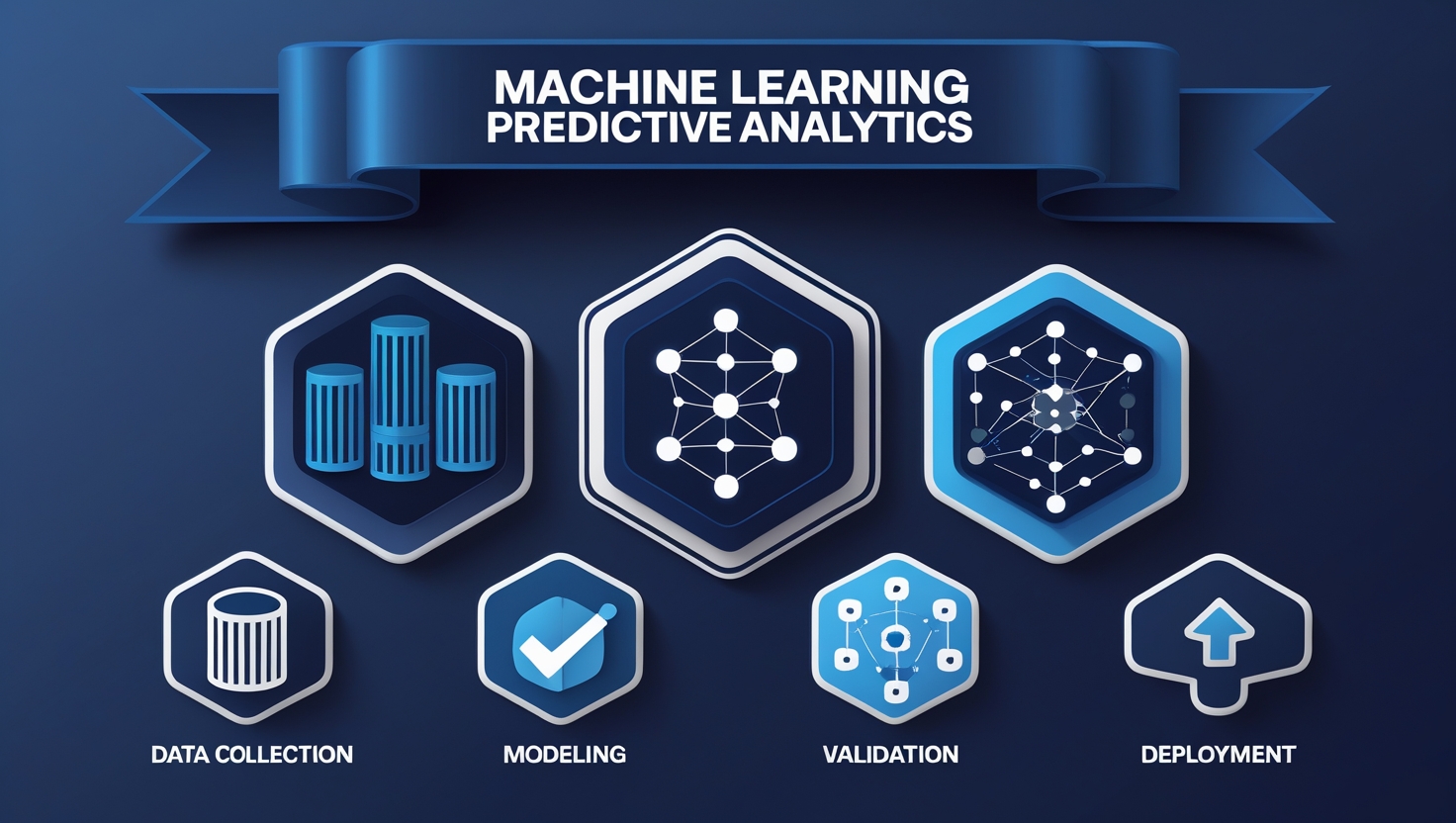
The journey begins with data preparation—collecting, cleaning, and organizing information. This critical first step often consumes up to 80% of project time but determines the ultimate success of any predictive analysis. High-quality data leads to high-quality predictions.
Next comes model development, where data scientists select appropriate algorithms based on the specific prediction needs. Common machine learning models include:
Linear regression for analyzing relationships between variables and predicting continuous values. This straightforward approach works well for simpler predictions like sales forecasts based on advertising spend.
Decision trees create clear visual representations of decision paths, making them excellent for classification tasks. These models excel at segmenting customers into distinct groups based on their behaviors.
Neural networks that mimic human brain function to recognize complex patterns. These sophisticated models power advanced applications like image recognition and natural language processing.
The final step involves validation and deployment, where models are tested against real-world data before being implemented. Successful organizations treat this as an ongoing process, continuously monitoring and refining their predictive models as new data becomes available.
The Double-Edged Sword:
Implementing machine learning predictive analytics offers substantial benefits but also presents significant challenges. Understanding both sides of the equation helps organizations prepare for successful adoption.
On the benefits side, organizations enjoy operational improvements through process automation and enhanced efficiency. A retail chain that implemented predictive analytics for inventory management reported a 30% reduction in stockouts while simultaneously reducing excess inventory by 25%.
Strategic advantages include improved decision-making based on data rather than intuition. Companies using machine learning for market analysis can anticipate trends before competitors, positioning themselves to capitalize on emerging opportunities. Netflix estimates that its recommendation system, powered by predictive models, saves the company $1 billion annually by reducing customer churn.
However, implementation isn’t without obstacles. Technical challenges include data quality issues, computational costs, and model complexity. Many organizations struggle with “dirty data”—incomplete, inaccurate, or inconsistent information that undermines prediction accuracy.
Organizational hurdles often prove even more difficult to overcome. These include skill gaps (data scientists remain in short supply), cultural resistance to data-driven decision-making, and resource allocation conflicts. According to Gartner, nearly 60% of predictive analytics projects fail to move beyond the pilot phase due to these organizational factors.
Emerging Trends in Predictive Technology:
The field of machine learning predictive analytics continues to evolve rapidly, with several exciting developments on the horizon. Understanding these trends helps organizations prepare for the future of data forecasting.
Agentic AI represents one of the most promising frontiers. These autonomous systems can execute tasks independently, from IT support to HR functions. Unlike traditional predictive models that simply provide information, agentic AI can take action based on its predictions, further streamlining operations.
AutoML (Automated Machine Learning) is democratizing access to predictive analytics by simplifying model development. These tools automate many technical aspects of creating predictive models, making the technology accessible to organizations without specialized data science teams. This democratization will likely accelerate adoption across industries.
MLOps (Machine Learning Operations) is emerging as a critical discipline for scaling machine learning initiatives. Similar to DevOps in software development, MLOps focuses on streamlining deployment, monitoring, and collaboration. This approach helps organizations move beyond pilot projects to enterprise-wide implementation of predictive analytics.
The Perfect Fit: Customizing Predictions for Specific Needs:
The most powerful predictive analytics solutions aren’t one-size-fits-all but rather tailored to specific organizational needs. This customization happens through several approaches.
Model modification involves adjusting parameters, confidence limits, and transformations to match the specific characteristics of the data and prediction goals. For example, a financial institution might adjust risk thresholds in fraud detection models based on its unique customer base and risk tolerance.
Industry-specific adaptation recognizes that different sectors have distinct prediction needs. A retail forecast focuses on different variables than a manufacturing prediction or a healthcare risk assessment. Successful organizations adapt their machine learning predictive analytics approach to their industry’s unique characteristics.
Implementation success factors include a clear objective definition, data quality management, and regular model evaluation. Organizations that excel at predictive analytics establish specific goals before implementation, maintain rigorous data standards, and continuously assess model performance against real-world outcomes.
The Future is Predictable (With the Right Tools):
As we’ve explored throughout this article, machine learning predictive analytics offers organizations powerful tools for anticipating future trends and making data-driven decisions. From fraud detection in banking to inventory optimization in retail, these technologies transform how businesses operate across industries.
While implementation challenges exist, the potential benefits—operational efficiency, strategic advantage, and competitive differentiation—make the effort worthwhile. As technologies like AutoML and MLOps mature, predictive analytics will become increasingly accessible to organizations of all sizes.
The future belongs to organizations that can effectively leverage data to anticipate customer needs, optimize operations, and identify emerging opportunities. By embracing machine learning predictive analytics and investing in tailored data forecasts, forward-thinking businesses position themselves for success in an increasingly competitive landscape.
FAQs:
1. What’s the difference between machine learning and predictive analytics?
Machine learning is a subset of artificial intelligence focused on creating systems that learn from data, while predictive analytics is the practice of using data to forecast future events. Machine learning provides the algorithms and techniques that power modern predictive analytics solutions.
2. How much historical data is needed for accurate predictions?
The amount varies by application, but generally, you need enough data to capture seasonal patterns and unusual events. For most business applications, 1-3 years of historical data provides a solid foundation, though some predictions can be made with less data if it’s high-quality and relevant.
3. Can small businesses benefit from machine learning predictive analytics?
Absolutely. With cloud-based solutions and AutoML tools, small businesses can implement predictive analytics without massive investments in infrastructure or specialized staff. Even simple applications like customer churn prediction or demand forecasting can deliver significant ROI for small organizations.
4. What types of predictions are most reliable?
Short-term predictions about well-understood phenomena tend to be most reliable. For example, forecasting next week’s inventory needs based on historical sales patterns is typically more accurate than predicting next year’s market trends. The reliability decreases as the time horizon extends or the system complexity increases.
5. How can businesses ensure ethical use of predictive analytics?
Ethical use requires transparency about data collection and usage, careful attention to potential biases in training data, regular auditing of model outputs for fairness, and human oversight of automated decisions. Organizations should establish clear ethical guidelines before implementing predictive analytics systems.
6. What’s the first step in implementing predictive analytics?
Start by clearly defining the business problem you want to solve and confirming you have sufficient relevant data. Many organizations begin with a small pilot project to demonstrate value before scaling to an enterprise-wide implementation. This approach builds organizational support while minimizing initial investment.