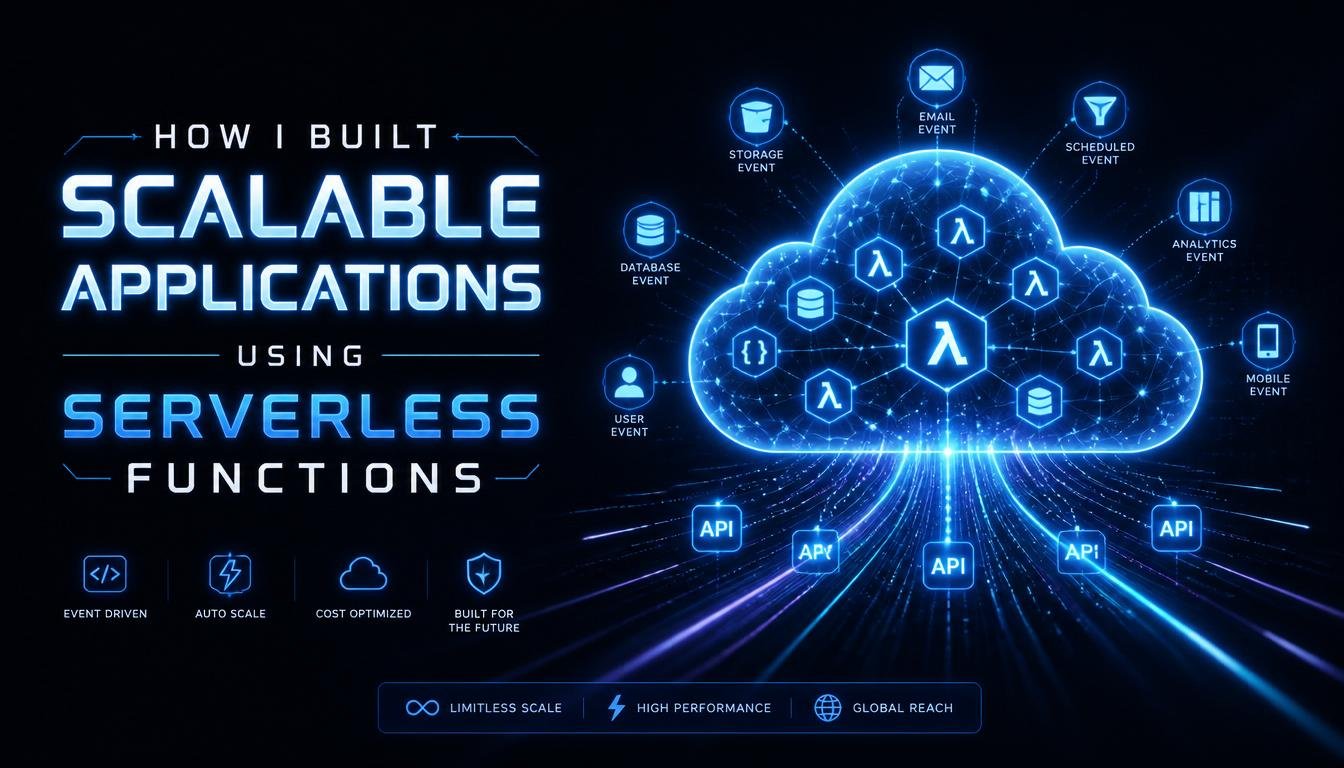
Managing servers used to feel like babysitting a needy Tamagotchi that screams at 3:00 AM because it ran out of memory. I spent more time configuring operating system patches and praying to the DevOps gods than actually writing code, until I finally snapped and decided to delete my servers entirely. If you are tired of paying for idle CPU cycles while your app gets zero traffic at night, welcome to my journey of how I built scalable applications using serverless functions and managed to reclaim my sanity.
Shifting From Infrastructure to Code:
In a traditional setup, you have to provision a virtual machine, configure load balancers, and guess your peak traffic capacity months in advance. Guess too low, and your app crashes; guess too high, and you burn your entire cloud budget on empty servers.
Switching to Function-as-a-Service (FaaS) completely flips this paradigm. Instead of managing a continuous runtime environment, you upload isolated snippets of code to a cloud provider. The provider handles all the underlying infrastructure management, OS patching, and network routing. Your code simply sits dormant until an HTTP request or database event triggers it into action.
Designing a Modern Event-Driven Architecture:
To build truly scalable applications, you cannot just copy-paste a giant monolithic codebase into a single cloud function. You have to break the system down into a decentralized microservices architecture.
In my architecture, an API gateway acts as the front door, intercepting incoming traffic and routing requests to specific, independent serverless functions. For example:
- POST /orders triggers an order placement function.
- GET /products triggers an inventory retrieval function.
If 10,000 users suddenly rush the checkout button simultaneously, the platform automatically spins up 10,000 parallel, isolated container instances of that exact function in milliseconds. Once the rush subsides, the containers vanish, and your active server footprint drops back to absolute zero.
Overcoming the Architecture Hurdles:
While going serverless sounds like a developer’s paradise, it comes with unique architectural trade-offs that can catch you completely off guard if you aren’t prepared.
1. Conquering the Cold Start:
The most notorious bottleneck in this ecosystem is the cold start. When a function hasn’t been executed recently, the cloud platform has to provision a new container, load your runtime environment, and initialize your application dependencies. This boot-up sequence adds noticeable latency to the very first request.
To mitigate this, keep your function deployment packages incredibly small, opt for lightweight runtimes, and utilize provisioned concurrency features to keep a warm baseline pool ready for high-priority user routes.
2. Navigating Vendor Lock-In:
When you build deeply integrated workflows using platform-specific triggers like AWS Lambda, you risk severe vendor lock-in. Migrating your entire ecosystem to a competing provider later can require a total architectural rewrite. To keep your application flexible, decouple your core business logic from the cloud provider’s wrapper code so you can swap out the execution layer easily if pricing or features change.
Conclusion:
Embracing serverless development completely changed my engineering philosophy. By offloading server provisioning and automatic scaling to managed platforms, I can focus entirely on shipping features rather than managing hardware. It isn’t a silver bullet for every single computing workload, but for modern, variable-traffic web applications, it is the ultimate way to build fast and stay lean.
FAQs:
1. What is a cold start in serverless computing?
It is the initial latency delay that happens when a cloud provider spins up a brand-new container to execute an idle function.
2. How does serverless billing differ from traditional hosting?
You are billed strictly for the exact milliseconds your code executes, rather than paying a flat hourly rate for a running server.
3. What is the role of an API gateway in a serverless app?
It acts as a reverse proxy to route incoming HTTP requests directly to the correct backend serverless functions.
4. Can serverless functions run long-running background tasks?
No, most cloud providers enforce a strict execution timeout limit, typically capped between 15 to 30 minutes.
5. What is an example of an industry-standard FaaS tool?
AWS Lambda is widely considered the most prominent and heavily utilized Function-as-a-Service platform in the industry.
6. Does a microservices architecture eliminate the need for databases?
No, it simply breaks logic into smaller pieces, which still rely on externally managed databases to store persistent data.